Multiple Well Configuration in MODFLOW with Model Muse Tutorial

Modflow with Model Muse are a powerful set of softwares developed by the USGS for groundwater modeling. Model Muse is very handy when working with GIS files but sometimes there are some specific requirements about the hydrogeologic features to conceptualize. This time we have prepared a tutorial about the multiple well configuration on a regional groundwater model. The tutorial deals with the model construction and configuration of 182 pumping wells on a 84km x 54km area in the north of Mexico.

Read More
How to insert a Geological Fracture on a Hydrogeological Model with MODFLOW and Model Muse

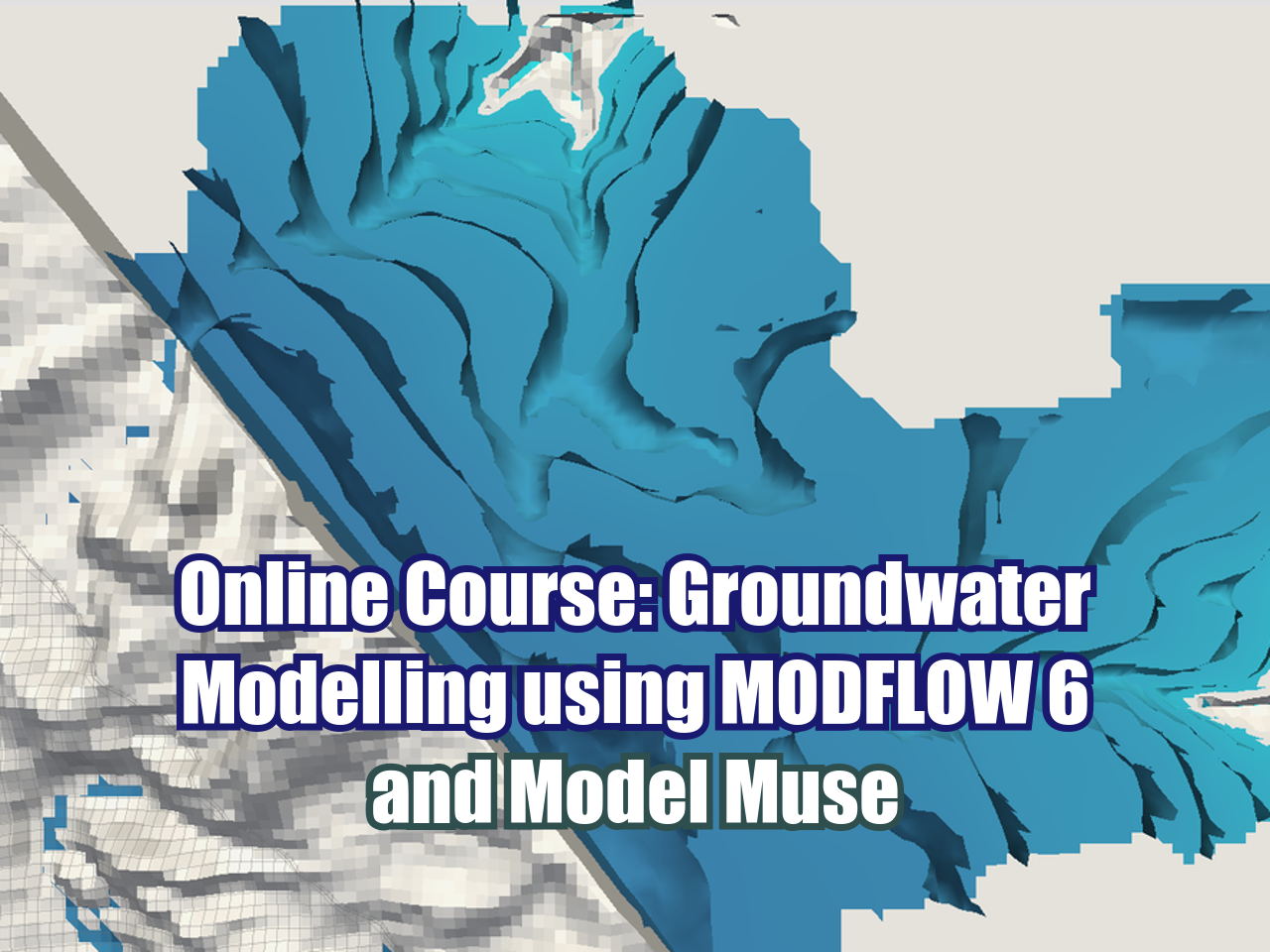
Model Muse is a software for the pre and post data processing of hydrogeological 3D model in MODFLOW. Both Model Muse and MODFLOW are developed by the USGS (usgs.gov). Model Muse is designed to work with objects and datasets, a powerful model construction methodology that allows the quick setup of boundary conditions, a simple way of progressive refinement and interesting features as inserting geological fractures on the numerical model.

This tutorial show the whole procedure for the conceptualization of several fractures based on some known fracture information as a point on the fractures, the azimuth and elevation. The tutorial deals with the theorethical determination of the fracture plane equation, the construction of a dataset with the desired equation plus the implementation of object that represents the fracture with the relevant hydrogeological features.

Read More

Tutorial of a Cross Seccion of Water Quality with MODFLOW, MT3DMS y QGIS

Groundwater flow modeling depends on GIS data, and its output is compatible with a sort of GIS tools. In order to do analysis or representation from contaminant transport modeling it is needed a sort of commands, formats, tools and plugins from a stack of programs as ModelMuse and QGIS.

This tutorial is not only a example of water quality representation, it is as well a discussión on the main parts of modeling construction and simulation.

Read More

How to insert a Geological Contact in MODFLOW with MODEL MUSE

Model Muse and QGIS makes possible to deal with geological data for the groundwater flow model cocntstruction. A diverse group of tools are required to process and insert geological features as contacts or faults. This tutorial show the whole procedure from the ground up to build the model geometry and insert a geological contact as the interfase within two layers.

Read More

Recharge Estimation by Daily Precipitation with MODFLOW UZF and Python

The processes of the superficial and groundwater water cycle are related to the precipitation (shape and intensity) and the dynamic of soil moisture. This dynamic of soil moisture is determined by the type of soil and the root zone in a daily, or even hourly, temporal scale. These phenomena have not been considered or studied in conventional hydrogeology text books, maybe because of their intensive use of modeling tools and complex conceptualizations and validations.

Read More

Using GRIDGEN V 1.0 to Generate Unstructured Grids

GRIDGEN is a program developed by the United States Geological Survey (USGS) to create unstructured grids to be used in numerical models such as MODFLOW-USG.

The use of unstructured grids has advantages, like the capacity of refining specific areas. However, its design and manipulation is more complicated than in structured grids. The most complex step is the creation of input data, specifically the ones related to cell connectivity. For this reason, GRIDGEN is an useful tool that helps to simplify the process.

Read More

Tutorial: How to convert MODFLOW-2005 files to MODFLOW-6 format

The United States Geological Survey (USGS) has just released a new MODFLOW version: MODFLOW-6. This one comes with new functionalities to make it easier to create input files and perform simulations. Among the downloaded MODFLOW-6 files, there is an executable file to convert MODFLOW-2005 files to the new MODFLOW-6 format. In this tutorial we will show you how to do this.

Read More

An overview of Freewat, the new MODFLOW interface in QGIS

A new and fresh opensource preprocessing and post processing tool is available. Freewat 0.4 was launched as a beta version and publicly available upon registration from this website: http://freewat.eu/. Most of the developers are italian and the project is funded under the H2020 program from the European Union and the Regione Toscana. The software comes with clear and descriptive documentation and tutorials plus the installation instructions. 
This article show the most important features of Freewat and its capabilities for representing the geospatially referenced regional groundwater flow.

Read More

7 Solved Questions about Conceptualization, Construction and Calibration of Hydrogeological Models

Constructing and calibrating numerical models can be a challenging task in terms of time, available data and professional abilities of the modeler. Since this work is usually done alone, there are many questions about the conceptualization of the physical environment, the construction of the model and the calibration with observed data. Based on the questions asked by some attendees of our webminars, we have written this article for all the confused hydrogeological modelers.

Read More

Key concepts for modeling groundwater flow driven by geothermal energy

For most hydrogeologists numerical modeling of groundwater flow is still new and brings several challenges when dealing with input data, model construction and simulation. Most of our modeling efforts are done in gravity driven groundwater flow on shallow aquifers solved by Darcy law equations. Sometimes we excel ourselves in conceptualizing "advanced" topics as unsaturated flow, contaminant transport, variable density or baseflow calibration. What about if we consider another driving force besides gravity? Will out lives be happier/miserable? Could we cope with the huge amount of required data?

Read More

How relevant is evapotranspiration in the groundwater flow regime?

Evapotranspiration is the mixed process of soil evaporation and transpiration of plants. This process is not included in many Hydrology books or in hydrological methods like the rational method, SCS, among others. Evapotranspiration is not relevant in when calculating maximum floods, but it is considered in water balances of superficial water and groundwater.

This article shows the relevance of the evapotranspiration process in the conceptualization and modeling of groundwater, indicating which would be the errors and inaccuracies of not considering this process.

Read More

What data do you need for hydrogeological modeling?

A hydrogeological evaluation needs a numerical representation of the groundwater flow regime. Numerical models are a great tool to evaluate the current and future conditions of groundwater flow. In order to make a model, it is necessary to have geological and climate data, among other types.

The following list describes the input data needed to carry out a hydrogeological modeling. The information required could be either in tabular or vectorial format.

Read More

How to Pythonify (modify and run with Python) a Pumping Test Model in MODFLOW

Working with graphical user interfases (GUIs) can be slow when one wants to do a severe trial-error runs on a groundwater flow model. Pumping test intepretation requires a lot of attemps in order to calibrate the steady and transient parameters as hydraulic conductivity, vertical anisotropy, specific storage and specific yield. 

This tutorial show a procedure to generate the modflow files and run them by scripts in Python. The process allows to setup a generic model for a pumping test interpretation where the pumping rates, and observed head can come in separate files or arrays.

Read More

Simulation of Radial Drains for Tailings Drainage with MODFLOW Tutorial

MODFLOW is a versatil and applied computer code written in Fortran capable of modeling groundwater flow on steady and transient conditions. MODFLOW can simulate a diverse sort of groundwater flow management cases due to its packages and solvers. This tutorial shows the application of MODFLOW for the simulation of radial drains in a mine tailings facility. The simulation considers 16 drains of 60 m length over a simulation period of 1000 days.

Read More

Key concepts to become a numerical modeler

Nowadays, water resources management requires a better understanding of nature and a superior evaluation of the impacts caused by humans. We are concerned and focused on sustainability because we live on a planet with limited resources and changing environments. In some way, we know that the actual changes are results from past and present actions along with the effect of nature cycles.

Read More

Simulation Tutorial of Heavy Metals Bioaccumulation at Wetlands with MODFLOW-MT3DMS

If we want to talk about concentrations, solutes and contaminant transport in groundwater, we need to mention the Source/Sink concepts and natural concentrations in groundwater. Sources represent solute mass entering the system, which could be representing spills or natural lixiviation processes. Sinks are the zones where water with solute concentrations leave the system.

Read More