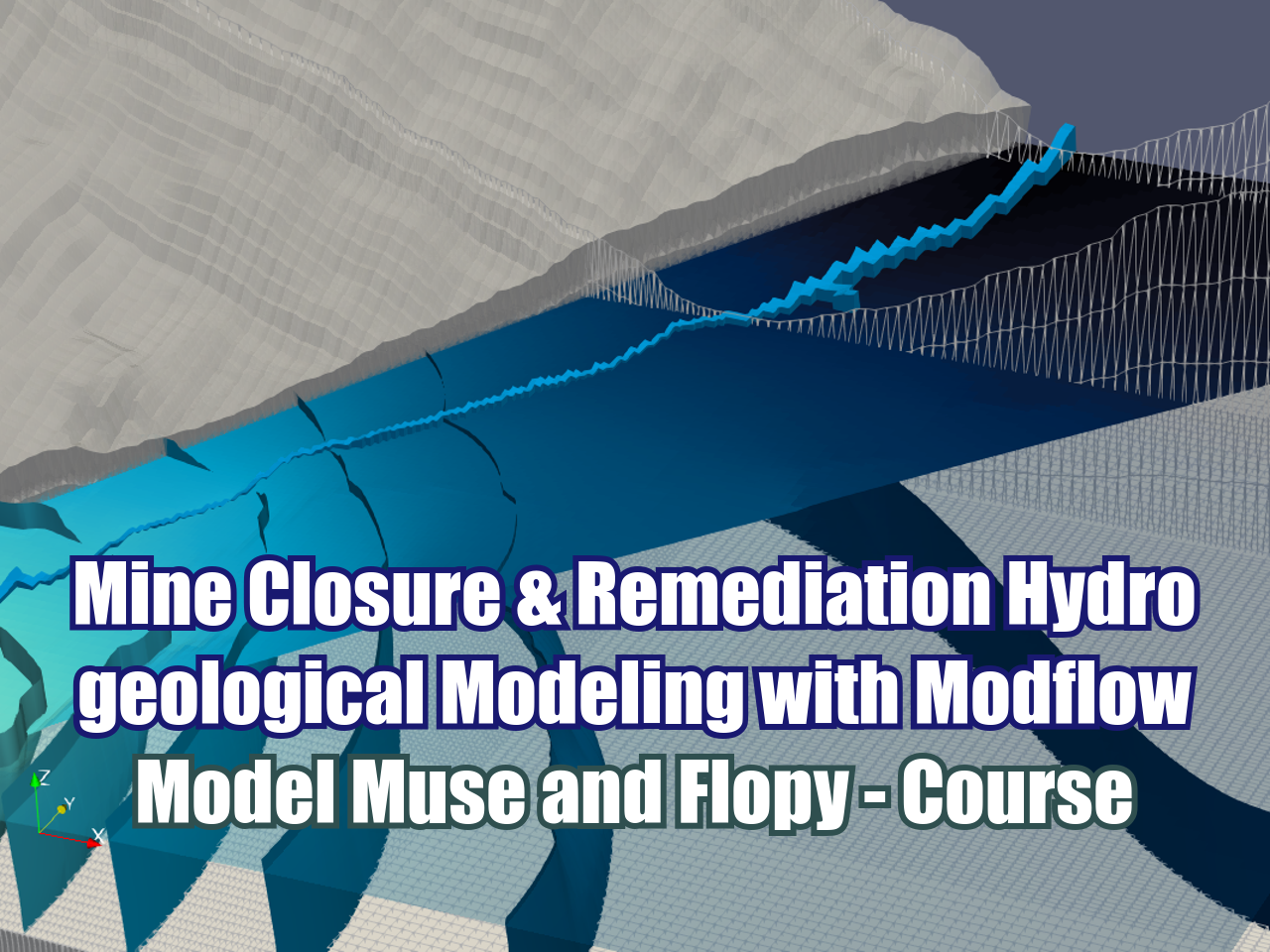
Tailing and waste dump seepage evaluation and remediation

Current and historical mining activities have a seepage and waste-dumps legacy that are the concern for mining companies, population and regulatory authorities.

Old waste-dumps have not been regulated and most of the old tailings have been deposited in soils without covering. Tailing deposits and waste-dumps should be analyzed in a particular way because of the ground, instalation details, mineralized body geology, mined type, weather and other parameters.

Recent mining activities count with major engineering in waste-dumps and tailing deposit instalations, as well as better monitoring evaluation seepage. However, there is still a seepage risk coming from old and new waste-dumps and their transport constituties a potential environmental issue.

Read More
Questions on MODFLOW with Model Muse

Some questions from a follower:

Thanks for agreeing to help. I developed a simple mode just to check if it works. But I get this error (attached). There are NO streams in my study area so do I still need to give my model a input for drainage package? I wanted to go around it but I could not proceed, therefore I created streams as drainage lines from DEM.

Read More

10 reasons why a hydrogeologist should know MODFLOW

Numerical modeling has become an important part on most hydrogeological investigations. We can even say that the use of numerical models is on “fashion” in decision making processes about groundwater resources.
Numerical models are mathematical interpretations of nature and groundwater flow. They can have limitations, but still they are the best tools available for the understanding of current groundwater flow conditions and the simulation of predictive scenarios on groundwater resources.
This post shows the 10 most important reasons why a common hydrogeologist should know MODFLOW. Reasons are classified among scientific, professional and others.

Read More

Assessment of land subsidence from pumping

The MODFLOW SUB-WT code has been developed to simulate vertical compaction in regional groundwater flow models due to pumping.

MODFLOW SUB-WT can simulate changes in groundwater storages and compaction in discontinuous layers or extensive confining units. The MODFLOW SUB-WT modeling code considers the compaction of a particular layer of the numerical model as a function of effective effort changes in the layer.

Read More

How to be a senior hydrogeologist in 6 years

When I was in second semester of my master degree, the course director gave me this advice: “Learn MODFLOW and you will have a job”. That was a small and sincere advice that helped me on the last eight years as hydrogeologist – numerical modeler. Nowadays, I want to give the guidelines for people interested in how to be a senior hydrogeologist in 6 years.

Read More

Available resources to learn MODFLOW with MODEL MUSE and Flopy

MODFLOW is a software for groundwater modeling developed by the USGS. The software is capable of representing conditions related to groundwater flow such as evapotranspiration, recharge, drainage, river interaction among others. Its finite different approach gives the capability to calculate the flow regime with exceptional control on water budget discrepancy. With MODFLOW one can rely on that the flow going in the model is the same as the flow going out of it, from the regional scale and on cross sections.

Read More

Main factors affecting groundwater regime

The concept of a groundwater regime is based on the fact that the occurrence and distribution of groundwater is not merely a product of chance, but the result of a combination of climatic, hydrologic, geologic, topographic and soil-forming factors that together form an integrated dynamic system. These factors are interrelated in such a way that each provides some insight into the functioning of the total system and thus serves as an indicator of local conditions of groundwater occurrence and distribution (PAEL, 1993).

Read More

Main predictive simulations for an EIA in mining

Impact assessment of mining projects on groundwater resources can be a challenging task due to uncertainty on groundwater flow regime, the complex numerical tools to successfully simulate stresses on groundwater resources posed by the mining projects, timeframe and budget of EIAs.

In this article, we will call EIA the document issued before the mine begins for regulatory official approval and social license.

Read More

Regional Groundwater Modeling with MODFLOW and Model Muse

Groundwater modelling can be done on multiple temporal and spatial scales, from a laboratory setup to a complete basin, from steady-state to thousands of years. Each modelling requirement has a specific discretization and boundary condition setup. This tutorial cover a regional groundwater modelling example on a andean basin on steady state conditions, the tutorial covers the whole set of modelling steps as grid generation and elevation import as well as the model simulation and result evaluation. Numerical modelling was done in open source software as MODFLOW with Model Muse, both developed by the USGS. 

Read More