Geochemical Simulation Tutorial of Water Mixing with Phreeqc

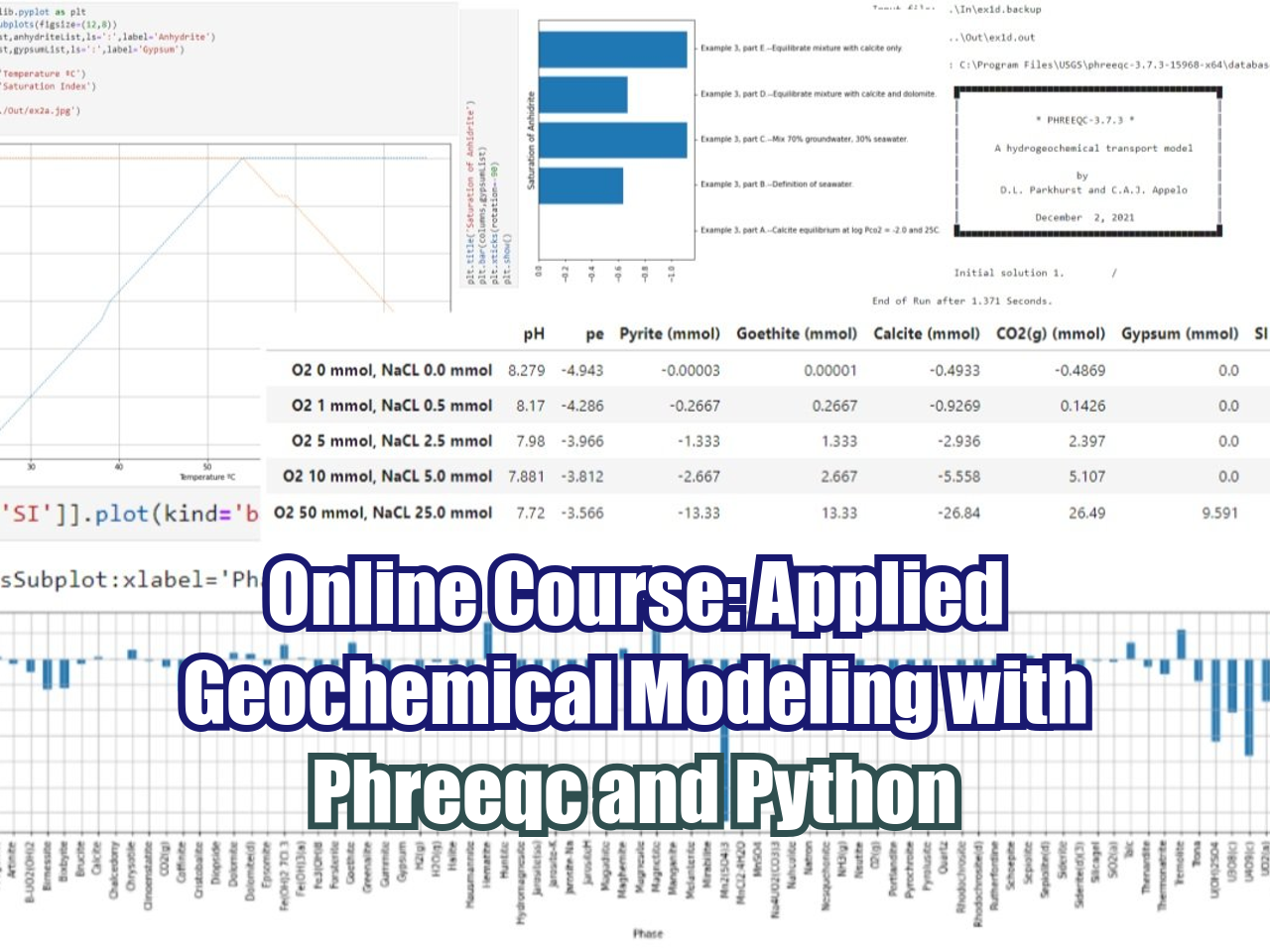
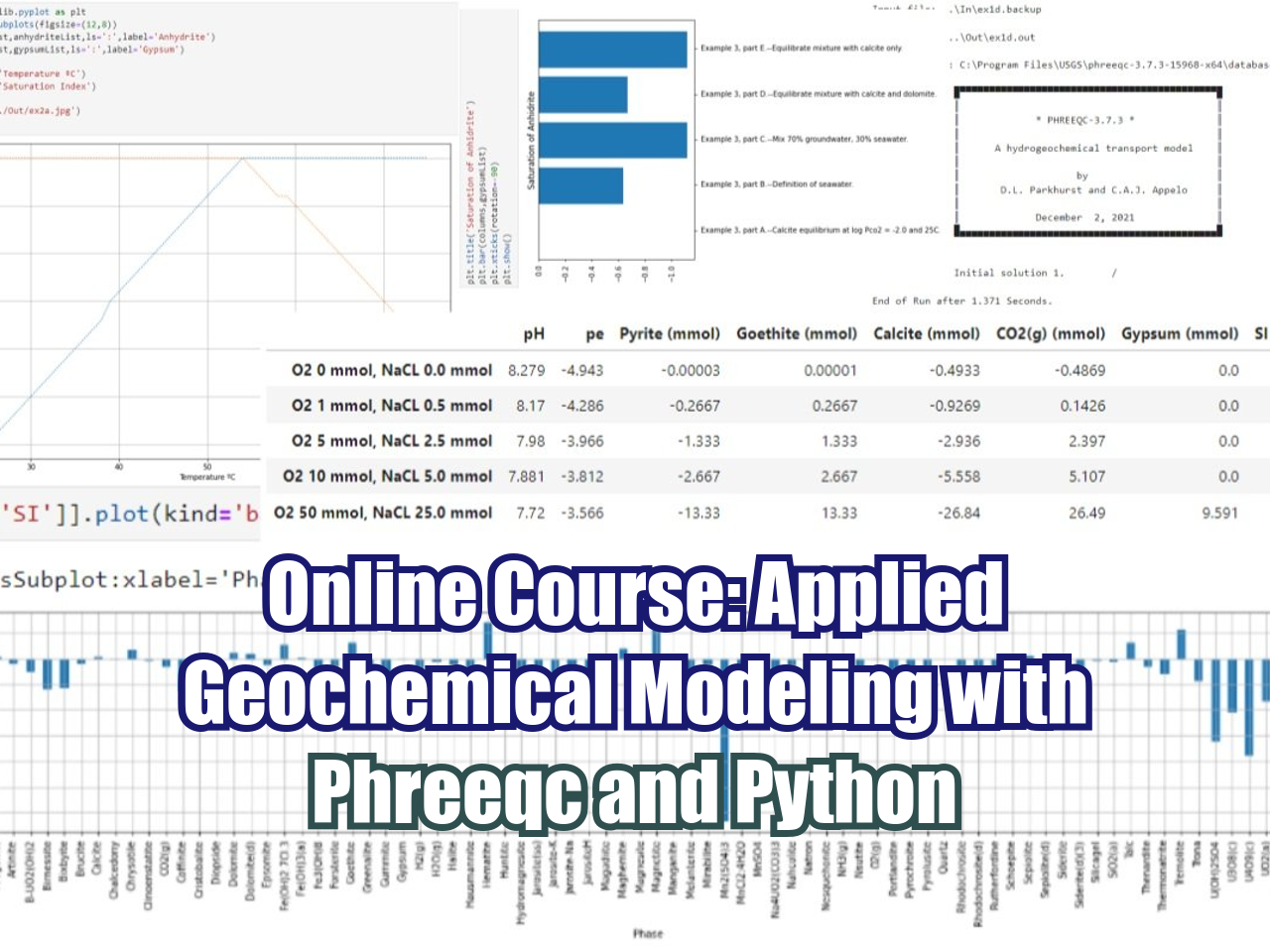
This example demonstrates the capabilities of PHREEQC to perform a series of geochemical simulations, with the final simulations relying on results from previous simulations within the same run. The example investigates diagenetic reactions that may occur in zones where seawater mixes with carbonate ground water. This example is take from the Phreeqc documentation that can be found here:

https://wwwbrr.cr.usgs.gov/projects/GWC_coupled/phreeqc/html/final-72.html

Read More
How to Pythonify (modify and run with Python) a Pumping Test Model in MODFLOW

Working with graphical user interfases (GUIs) can be slow when one wants to do a severe trial-error runs on a groundwater flow model. Pumping test intepretation requires a lot of attemps in order to calibrate the steady and transient parameters as hydraulic conductivity, vertical anisotropy, specific storage and specific yield. 

This tutorial show a procedure to generate the modflow files and run them by scripts in Python. The process allows to setup a generic model for a pumping test interpretation where the pumping rates, and observed head can come in separate files or arrays.

Read More

Solubility and Thermodynamic Stability of Gypsum and Anhydrite with Water with Phreeqc

PHREEQC version 3 is a computer program written in the C and C++ programming languages that is designed to perform a wide variety of aqueous geochemical calculations. PHREEQC implements several types of aqueous models: two ion-association aqueous models (the Lawrence Livermore National Laboratory model and WATEQ4F), a Pitzer specific-ion-interaction aqueous model, and the SIT (Specific ion Interaction Theory) aqueous model. Using any of these aqueous models, PHREEQC has capabilities for (1) speciation and saturation-index calculations; (2) batch-reaction and one-dimensional (1D) transport calculations with reversible and irreversible reactions.

This tutorial shows how to calculate the solubility and relative thermodynamic stability of two minerals, gypsum and anhydrit as a function of temperature at 1 atm.

Read More

Simulation of Radial Drains for Tailings Drainage with MODFLOW Tutorial

MODFLOW is a versatil and applied computer code written in Fortran capable of modeling groundwater flow on steady and transient conditions. MODFLOW can simulate a diverse sort of groundwater flow management cases due to its packages and solvers. This tutorial shows the application of MODFLOW for the simulation of radial drains in a mine tailings facility. The simulation considers 16 drains of 60 m length over a simulation period of 1000 days.

Read More

How to install Phreeqc on Notepad++

PHREEQC version 3 is a computer program written in the C and C++ programming languages that is designed to perform a wide variety of aqueous geochemical calculations. PHREEQC implements several types of aqueous models: two ion-association aqueous models (the Lawrence Livermore National Laboratory model and WATEQ4F), a Pitzer specific-ion-interaction aqueous model, and the SIT (Specific ion Interaction Theory) aqueous model. Using any of these aqueous models, PHREEQC has capabilities for (1) speciation and saturation-index calculations; (2) batch-reaction and one-dimensional (1D) transport calculations with reversible and irreversible reactions.

Read More

Simulation Tutorial of Heavy Metals Bioaccumulation at Wetlands with MODFLOW-MT3DMS

If we want to talk about concentrations, solutes and contaminant transport in groundwater, we need to mention the Source/Sink concepts and natural concentrations in groundwater. Sources represent solute mass entering the system, which could be representing spills or natural lixiviation processes. Sinks are the zones where water with solute concentrations leave the system.

Read More